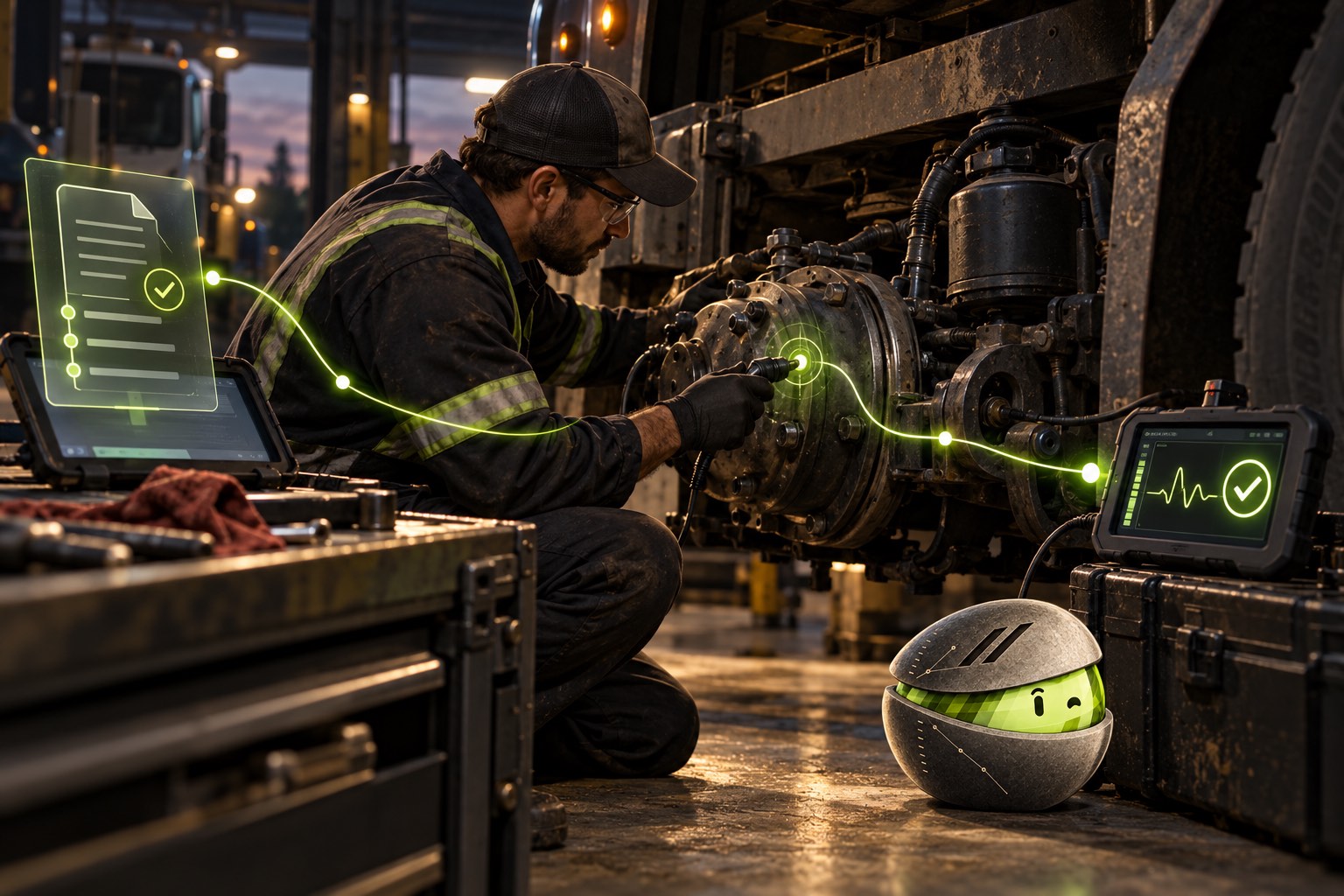
A file tells you something happened. The connections let you ask what changed—and whether the evidence supports it.
SYN
A fictional example, open for inspection. Every person, event, measurement and permission in this archive is synthetic. It demonstrates a method, with deliberate gaps. It establishes no real supply, clearance or model performance.
⌘ WORKSHOP / MAINTENANCE / EP-042
Source records
Follow the sequence
Events → sources
Select a record to inspect its contents.
Read EP-042 as a complete text episode Timeline, sources and missing follow-up
EP-042 / Fictional Pump A / Text edition
The first PASS did not end the story.
All records below are invented. This text edition is part of the page and can be read without JavaScript. The evidence levels describe what each fictional record contains, not independent verification of a real event.
The first check is marked PASS, then the same symptom is reported again. A later intervention has a recorded PASS and a bounded follow-up report. Cause and lasting efficacy remain unverified.
The EP-042 timeline
A symptom enters the record
An operator reports intermittent flow interruption on fictional Pump A.
Operator report: intermittent flow interruption was noticed during ordinary use of Pump A. The symptom was not independently verified in this intake note. No cause was assigned. This is a fabricated report, not real operational evidence.
SYN-R-002 · Recorded in example
Initial review note
Reviewer note: the interruption symptom was recorded during review. The note contains no raw diagnostic signals, calibrated measurements, photographs, or independently verified root cause. Any interpretation beyond the stated observation remains a hypothesis.
SYN-R-003 · Recorded in example
Initial intervention recorded
Activity record: initial intervention completed on the identified asset. Intervention details are intentionally omitted from this educational example. This note supplies no repair instructions, robot actions, tool trajectories, force data, or sensor measurements. Completion of an action does not establish successful or lasting repair.
SYN-R-004 · Recorded in example
Initial check marked PASS
Acceptance note: the scenario's routine function check is marked PASS. This note describes acceptance at that moment only. No independent measurement series or detailed acceptance protocol accompanies the note. Durable repair, causal efficacy, and later performance have not been established.
SYN-R-005 · Reported in example
Same symptom reported again
Operator report: the intermittent flow interruption returned on Pump A. The follow-up work order explicitly references the initial work order and the same asset ID. The report supports a recorded recurrence of the symptom after the earlier PASS. It does not establish the same underlying cause or prove that the initial intervention caused the recurrence.
SYN-R-006 · Reported in example
Alternative hypothesis noted
Reviewer report: an alternative explanation should be considered before the next intervention. The explanation is a hypothesis, not a verified diagnosis. Diagnostic specifics are intentionally omitted. No raw telemetry, calibrated readings, or independent root-cause review are attached.
SYN-R-007 · Recorded in example
Second intervention recorded
Activity record: a different intervention was completed under the follow-up work order. Details are intentionally omitted. This note does not provide a mechanical procedure, control policy, robot trajectory, or measured action signal. The relation between this intervention and subsequent status is chronological, not a proven causal relation.
SYN-R-008 · Recorded in example
Second check marked PASS
Acceptance note: the scenario's repeated routine function check is marked PASS after the second intervention. The note records acceptance for that check only. No independent measurement series or detailed test protocol is provided. This is not proof of a verified root cause, a guaranteed lasting repair, or suitability for training a model.
SYN-R-009 · Reported in example
Bounded follow-up report
Operator follow-up: no recurrence was reported between the second acceptance on May 8 and this May 15 follow-up. This is a self-report in the fictional record, not continuous monitoring or independent verification. There is no later follow-up for this asset in the pack. Events outside the recorded window are unknown.
SYN-R-014 · Unknown in example
Fictional rights and evidence register
Demonstration register: all people, assets, records, IDs, observations and permissions in this pack are invented. No actual enterprise data was used. Real-world ownership and controller authority: UNVERIFIED. Contractual licensing authority: UNVERIFIED. Worker or customer permissions: UNVERIFIED. Confidentiality and third-party restrictions: UNVERIFIED. Derivative and model-use rights: UNVERIFIED. These placeholders are not executed permissions, a legal assessment, or a grant over any real records. Stable joins and file hashes do not establish authenticity, lawful use, or ownership.
The missing follow-up and the limits
EP-042: SYN-R-009 reports no recurrence between the May 8 acceptance and the May 15 follow-up. There is no later follow-up for Pump A in this pack. Long-term outcome is unknown. The PASS notes do not establish a root cause or causal efficacy, and their detailed criteria and independent measurements are absent.
EP-043, the contrasting case: SYN-R-010 reports a similar symptom on a different asset, Pump B. SYN-R-011 proposes further work without confirming an intervention. SYN-R-012 records administrative CLOSED status, not technical success. SYN-R-013 records an unanswered outcome request: no response or acceptance evidence is present at the June 12 cutoff. Outcome is unknown; neither success nor failure can be inferred from the missing follow-up.
Rights and reuse: SYN-R-014 is a fictional placeholder. Stable IDs, chronology and file hashes establish no actual ownership, permissions, rights clearance, real inventory or model performance.
How to read the evidence levels
Recorded
Explicitly recorded in a fictional observation or activity note. Not a real observation or verification that the note is true.
Reported
Stated by a fictional operator or reviewer; independently unverified.
Inferred
An interpretation drawn from the cited fictional records, with limitations retained.
Unknown
The cited fictional records do not establish the answer. Absence is not proof of success or failure.
02 / What the connections changeA claim → its evidence → its limits
The useful part is the history.
What did someone notice? Which explanation did they try? What happened next? What would change your mind?
An archive can preserve those questions across work orders, messages, tests and revisions. Preparing it starts with finding the connections—and keeping the missing pieces visible.
A documented outcome supports a statement about that test. It does not, by itself, prove causality or generalize to another task.
01
Keep the source.
Every interpretation should lead back to an inspectable record.
02
Keep the failures.
The first plausible intervention may tell a different story after follow-up.
03
Keep the gaps.
Unknown origins, missing follow-ups and unresolved rights stay explicit.
03 / Take it apart
Useful enough to take with you.
The records, their connections and the questions we would ask next. All in one small, inspectable example.
Tell Drew which systems hold the records, roughly how far back they go, and whether the pieces connect. A non-sensitive description is enough to start a conversation about a first sample.
Please leave personal data, customer files and confidential details out of the first message.
Need evidence for a task?
Tell us what your system needs to do, the decisions you need to inspect, and what would count as a useful outcome. We can discuss a sourcing brief around that question.
This is an authored, synthetic demonstration by Archive Signal. It is not a customer case study, a technical repair procedure, a marketplace listing, or a model benchmark. The example contains no actual sensor recordings, robot action trajectories or cleared commercial archive.
Source inspection, chronology and consistent IDs help organize evidence. They do not establish permission to license, adequate anonymization or fitness for a buyer’s purpose. Those require their own review.