
Everyone’s having the wrong conversation about AI. It goes like this: the machines are getting smarter, the jobs are disappearing, and one day the whole thing wakes up and decides it doesn’t need us anymore. Fear all the way down.
I think the fear is pointed at the wrong thing. And oddly enough, virology offers a useful way into it.
The deadliest viruses rarely become the most persistent.
Pathogens that kill hosts too quickly often struggle to sustain transmission. Ebola outbreaks can be devastating, but they tend to burn through available transmission chains rather than spread indefinitely.
The viruses that win over time—the colds, the flus, the ones that have been with us forever—are the ones that keep the host alive and moving through the world.
AI is not a virus, and the analogy is not a theory of machine motivation. It is a reminder about systems: a system that destroys the physical substrate it depends on undermines its own reach.
A superintelligence that wipes out humanity also wipes out the power grid, the chip fabs, the supply chains, the millions of human hands that maintain everything it runs on. There is no AI without a physical substrate, and for the foreseeable future, humans are load-bearing members of that substrate.
It doesn’t need to love us. It needs the world to keep working.
Partnership, not surrender.
The future is not best understood as humans versus machines. It is humans with machines: a new division of labour, with people setting direction and intelligent systems extending what people can do.
Now here is the part nobody says out loud, and it is the whole ballgame:
That makes skilled human knowledge more valuable, not less.
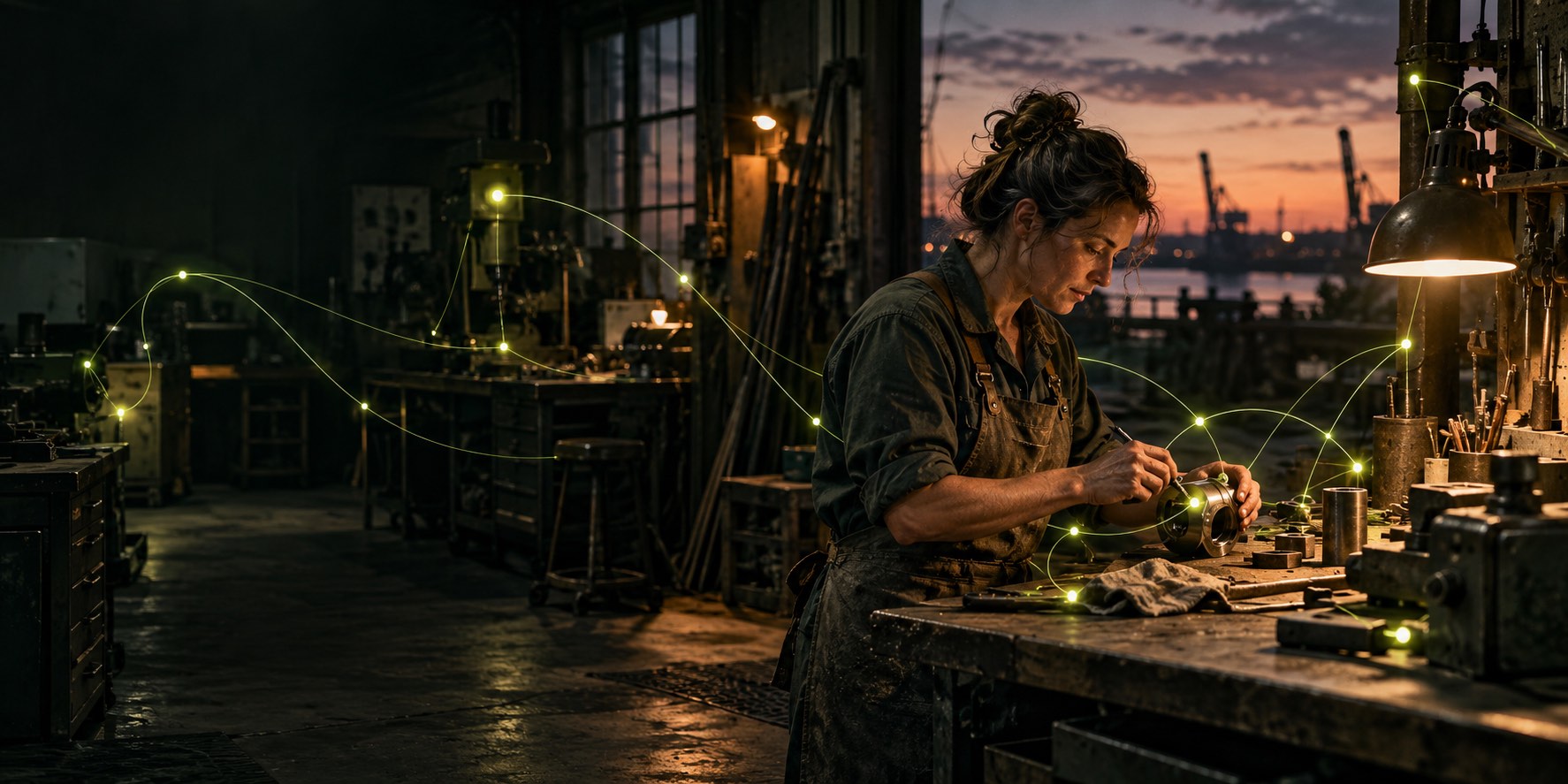
Machines do not need your ability to lift a box. They need what your hands know—the judgment in a welder’s arc, the feel in a machinist’s cut, the thousand micro-decisions a tradesperson makes without thinking. The stuff that took decades to learn and cannot be downloaded from a manual.
What is easy for a skilled human is often the hardest problem in robotics.
You are not the thing being replaced. You may be the teacher the future needs.
Every shop with forty years of knowledge in its walls, every tradesperson with skill in their hands, every operator who can recognize a failure before the instruments do—that is an asset. The question is how to share it on terms you control.
The wrong question.
Stop asking only whether AI will replace you. It is the wrong question, and it keeps you scared.
Ask instead: what do I know that it needs to learn?
That question turns panic into leverage. It does not require you to hand over your business, your people or your life’s work. It asks you to identify the rare judgment you already possess and decide whether, where and how it can be documented or licensed.
Three moves while the window is open.
- Inventory the irreplaceable. What does your team recognize, diagnose or adapt to that a new hire cannot learn in a week?
- Set the boundary before sharing. Define what stays private, what may be anonymized, who can access it and what a legitimate use looks like.
- Start with a bounded pilot. A short brief, a small number of experts and explicit rights terms can teach you more than a grand promise—or a reflexive refusal.
The fear is not stupid. Powerful systems deserve respect, and no one should be pressured into sharing knowledge they do not understand how to protect. But fear is a bad map. Bad maps make people walk off cliffs they never needed to approach.
The machines need a teacher. You get to decide whether to be one—and on what terms.
The virology framing is a systems analogy, not a claim about AI motives or a prediction that advanced systems will be safe. Views expressed here are Archive Signal’s editorial position.