
On October 5, Schneider Electric—a French company—agreed to buy PTC for $22.6 billion. It is the biggest deal in Schneider’s history, at a 42.3% premium. The financial press is covering it as an industrial-software story.
It is not just a software story. It is a data story. Schneider’s own announcement says PTC adds the product and engineering data layer to an industrial AI foundation already spanning processes and energy systems.
PTC makes Creo, the CAD software thousands of manufacturers use to design physical products. Its portfolio also reaches into product lifecycle, application lifecycle and service lifecycle management. The deal joins design intent to the operational context where physical systems are built, run and maintained.
That is the part worth sitting with. Data is becoming a critical layer—and the race is not only to collect more of it. It is to secure the records that come with proof.
Why this data is worth billions.
Data is everywhere. Proven data is not.
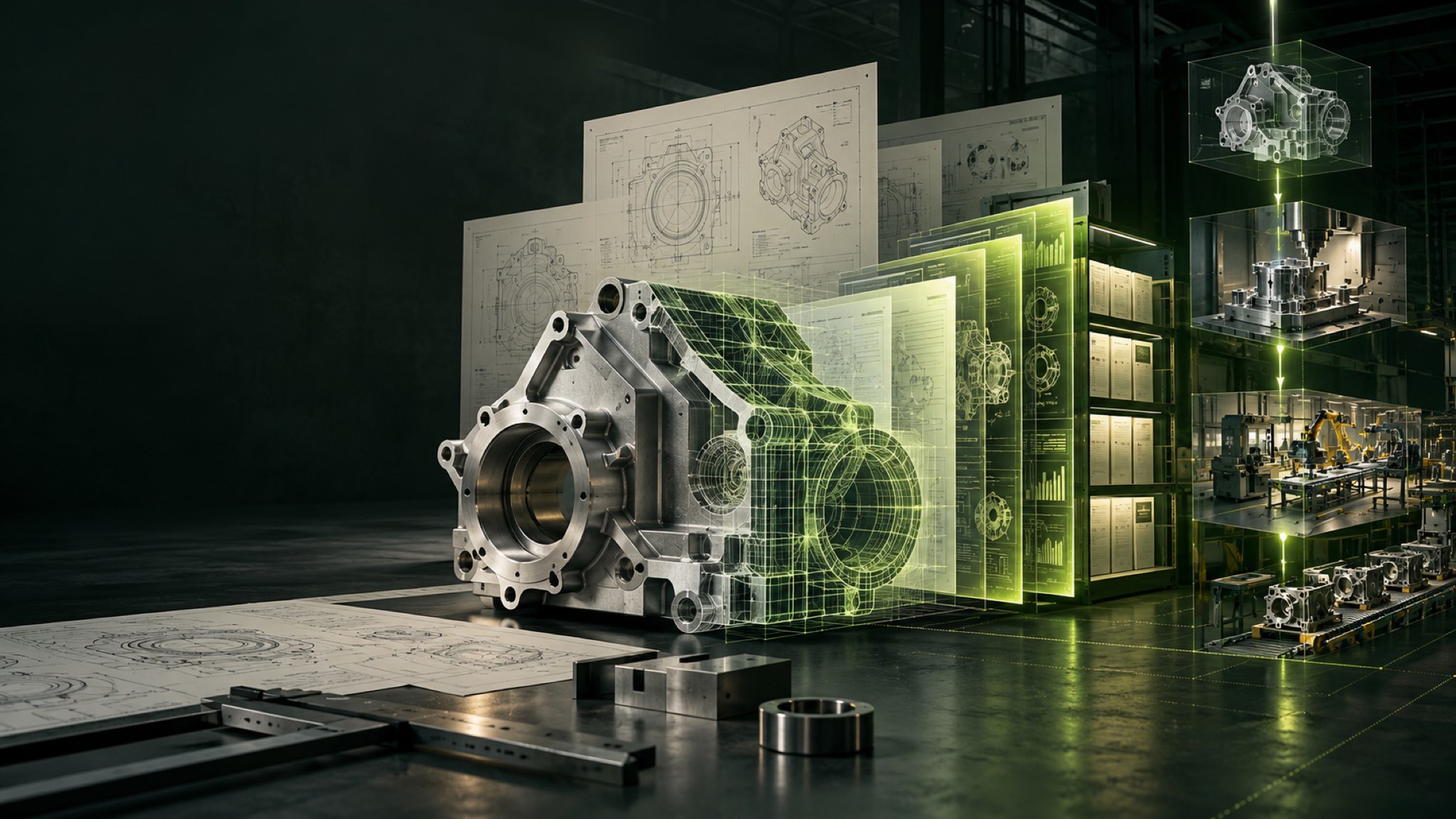
A PTC record is connected to a real product: something designed, manufactured, shipped and either worked or failed. The file is not merely an abstract example. It sits inside a chain of decisions and outcomes. That context is what makes the archive useful to industrial AI.
The industry is drowning in unproven data and starving for evidence. Schneider just paid a 42.3% premium for a company whose value is tied, in part, to the design and engineering records inside that chain.
The scarce input is not data in the abstract. It is evidence attached to an outcome.
The part nobody’s talking about.
With PTC going French, the ownership map beneath American product design changes again.
A b-rep kernel is the geometry engine inside CAD software—the mathematics that turns a drawing into something that can be manufactured. Every dimension, tolerance and fillet runs through one of a small number of kernels. Parasolid is owned by Siemens. ACIS is owned by Dassault Systèmes. C3D is Russian. Open CASCADE is French. Creo’s kernel was American. Now it is French.
That is not a simplistic argument about national origin. It is a reminder that the stack underneath industrial intelligence has owners, jurisdictions and accumulated memory.
The moat was never only the math. It was forty years of edge cases, broken models and hard-won fixes. The incumbent knows what fails because it has kept the record of what failed before.
The sovereignty problem runs deeper than data.
Our earlier argument was that Canada is building sovereign AI on somebody else’s data. The PTC deal shows the problem runs one layer deeper.
It is not just the training data that is rented. It is the tools, the formats and the geometry engines underneath it. You cannot have sovereign industrial intelligence on somebody else’s math, somebody else’s formats and somebody else’s archive of failure.
Watch what they are assembling.
PTC does not join Schneider alone. In June, Schneider agreed to acquire Cognite, an industrial data and AI company, for $3.1 billion. AVEVA already anchors the operations layer.
Design data. Industrial data. Operations.
That is a vertically integrated pipeline from engineering drawing to AI-run factory floor. Someone with very deep pockets has decided that the scarce input in industrial AI is the record of how physical things get designed, built and run.
No new technology fixes the archive problem.
A better model cannot manufacture the missing history of what was designed, attempted, rejected, repaired or proven in the field. The value is already in the record. The race is to identify it, govern it and secure it before the window closes.
The trade the market keeps missing.
Here is what $22.6 billion does not buy: the bottom of the stack.
Schneider bought the software, the platform and the enterprise contracts. But the actual record of how things get built does not live only in PTC’s servers. It lives in CAD archives, job folders, weld procedures and setup sheets inside thousands of small manufacturers—the welding shops, steel fabricators and tool-and-die makers whose owners are retiring and whose archives are still valued at zero in the business sale.
The strategic buyers are not rushing because data is about to become worthless. They are moving because owners are about to realize it is valuable, and because the best archives will become more expensive once that realization spreads.
- If you own a physical business, decades of design and job records may be the input the biggest industrial deal of the year was built to capture. Price it before someone else does.
- If you are building industrial AI, the bottleneck is not only the model. It is the proven archive. Whoever owns the evidence sets the terms.
- If you care about sovereignty, the data layer was the shallow end. The geometry engine just changed flags.
The receipt is the product.
The market prices the past. Schneider just paid $22.6 billion for the future. The gap between those two numbers is where the opportunity lives.
Not because every archive is suddenly worth a fortune. Because the right archive—documented, outcome-linked, rights-clear and held by someone who understands its leverage—is no longer invisible.
The window is longer than a panic sale. But it is not open forever.
The Schneider Electric–PTC transaction terms and stated industrial-AI rationale come from PTC’s October 5, 2026 announcement ↗ and the related SEC filing ↗.
The Cognite transaction is documented in Cognite’s announcement ↗.
The geometry-kernel ownership discussion is a high-level editorial framing, not a legal or technical opinion. This note does not claim access to private Schneider Electric, PTC or customer systems.