
The deal table teaches you to read silence. Lately there has been a lot of it, and it follows a pattern I think much of this market is misreading.
A major buyer spends weeks deep in a consumer archive. Calls, samples, real engagement. Then the answer comes back that they have pivoted to B2B, or there is no answer at all. Response times that used to be measured in days are now measured in weeks, when answers come at all.
The easy conclusion is that the AI data market is cooling. It might be. A stalled conversation can mean a budget reset, an internal reorganization, a rights problem, or preparation costs that make the deal unattractive. Silence alone cannot distinguish those explanations.
But my working interpretation is that some buyers are becoming more specific about what they still need. I'm reading a narrow sample, my own pipeline, so take this as an operating hypothesis, not a market finding. The labs may not be finishing with data. They may be finishing with the next undifferentiated version of a category they already hold.
The next million records have to add something
The first wave of buying, as I read it, went after corpora closest to what the labs already knew how to use. Call-centre recordings. Ecommerce and SaaS operating history. Marketing archives. Support conversations. Generic code. Much of it was already digital and relatively accessible, even when the rights and preparation were complicated.
A buyer with millions of support calls may still need more. But the next million have to contribute something the existing corpus lacks: a different workflow, a rare failure, an expert correction, or a reliable connection between an action and its outcome.
That is a narrower claim than saying a category is exhausted. It is also more useful to an owner. The question changes from “Do you buy support calls?” to “What can these records teach you that your current material cannot?”
Public evidence shows buyers still assigning substantial value to enterprise records. Google was selected at $10 million in the Spirit Airlines data auction; micro1 subsequently proposed a competing $12.5 million offer. Those are distinct events, and auction selection is not the same as a completed sale. They demonstrate interest in one unusual archive, not a price floor for everyone else's.
Two changes could be happening at once
There are two possible markets here, and they should not be confused.
First, frontier buyers may be moving toward more specific operating knowledge: B2B workflows, physical-world records and environments that test whether an agent can complete real work. A system expected to work reliably in welding needs evidence of welding as it is actually practised. Historical records may supply failure cases and verified outcomes that demonstrations alone miss. Simulation, newly captured demonstrations and deployed experience may supply other parts of the answer.
Second, newer labs, open-model efforts and vertical specialists may still want categories that another buyer already holds. One lab's reduced appetite does not settle another lab's requirements. That is a reason to investigate additional buyers, not a guarantee that a second cohort will arrive.
An environment has to earn its premium
Handshake's ATLAS-Finance is a useful example of requirements getting more specific. It puts agents through 100 expert tasks across 13 realistic financial-firm environments. In its published version 1.0.0 evaluation of eleven frontier models, the highest pass rate was 12.3 percent under its stated passing criteria.
That result does not prove a shortage of training data, and it should not be compared directly with scores from differently designed benchmarks. It shows a concrete evaluation target: completing professional work with scattered context, tools and explicit standards for the result.
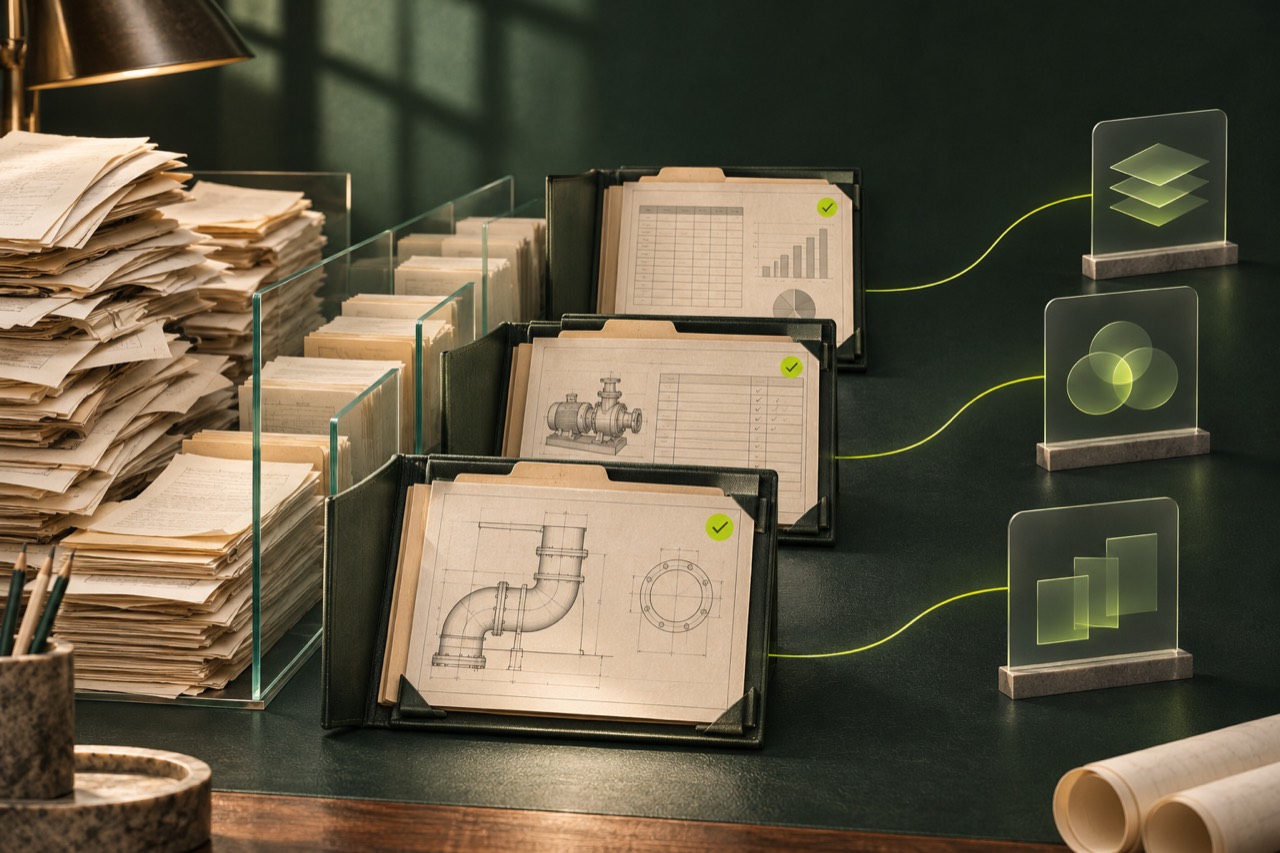
An archive becomes an environment only through work: clearing rights, reconstructing the workflow, defining a correct result and testing a capability the buyer needs. The premium has to justify the preparation.
The same distinction matters in physical AI. Flikforge, a vendor that sells data preparation and enrichment, reports that undifferentiated egocentric footage can trade in bulk for as little as $2–5 per hour. StartupFeed separately reports an industry executive's observation that collection rates in India fell about 30 percent between January and June 2026. Neither is a comprehensive market price index.
Still, they are a useful challenge to the comfortable version of our thesis. Physical-world data already contains commodity segments. Being hard to scrape is not enough. The record must be relevant, usable and difficult to substitute for the particular job.
Why the terms matter more than the first price
If different buyers have different requirements, an owner should understand what the first agreement leaves available for the next one.
A perpetual exclusive can look like the biggest cheque and still give up more than the price reflects. But a short licence is not a reset button either. Its expiry does not necessarily end permitted use of models trained during the licence period. The duration of access, the scope of exclusivity, onward licensing and rights in trained models or derived materials are separate questions that the agreement needs to answer.
My starting preference is retained ownership, defined uses and non-exclusive licensing where the data supports it. Exclusivity can be worth selling for a defined field and term, at a price that reflects the opportunities the owner gives up.
The point is to price those choices deliberately. A ten-year restriction on every use should not slip into a transaction priced for one immediate training objective.
That applies to us as well. If Archive Signal proposes a longer or exclusive arrangement, the owner should see what is being restricted, why it is needed, what it pays for, and the argument for keeping those rights available instead.
What would change my mind
Our focus remains service records, repair histories, industrial workflows and the records of skilled work. These are places where we think relevant, outcome-linked experience may be difficult to replace. That is a position to test, not a promise of repricing.
Repeated rejection of well-matched, rights-cleared archives would count against it. So would buyers consistently preferring newly generated or synthetic substitutes, or declining to pay enough to cover the cost of making the records useful.
The evidence in favour would be specific requests, paid pilots, repeat licences and buyers returning for new outcomes from the same workflow. Those would tell us more than broad enthusiasm about “data.”
The market may not be ending. It may be graduating, from buying volume to specifying what the next record must contribute. Some categories may still commoditize, and some archives may never support a commercial licence.
For owners, the useful response is the same: preserve the record, establish what rights you can grant, test it against actual demand, and understand what each deal leaves available. An archive may support multiple licences. The first conversation should help reveal that possibility, not quietly decide it forever.
Drew Clement is building Archive Signal: rights-cleared, outcome-linked physical data. The answer keys AI trains against.
- Spirit Airlines Consumer Privacy Ombudsman, supplemental report filed October 5, 2026, documenting Google's selection and micro1's subsequent notice of a competing proposal. Fast Company, August 21, 2026, reports the $10 million and $12.5 million amounts. Auction selection and a subsequent proposal should not be read as confirmation of a completed transaction.
- Handshake, “ATLAS-Finance: Evaluating AI Agents Inside a Bank.” Figures refer to the published version 1.0.0 evaluation, with rollouts and grading conducted September 3–10, 2026; they are not a claim about the latest leaderboard.
- Flikforge, “The Great Robot Data Glut.” July 7, 2026. The bulk-pricing observation comes from a vendor with a commercial interest in data preparation and enrichment.
- StartupFeed, “Egocentric Data: India's Bold Bet To Train World Robots.” July 1, 2026. The reported collection-rate decline is attributed to an industry executive; it is not a market-wide price index.
The observations about buyer behaviour come from my own conversations and are a narrow sample. They are my reading, not a finding. Archive Signal works on operational archives and physical-AI data sourcing and could benefit if markets for those develop. Archive Signal has a partner deal with Handshake, whose ATLAS-Finance benchmark is discussed in this article.