
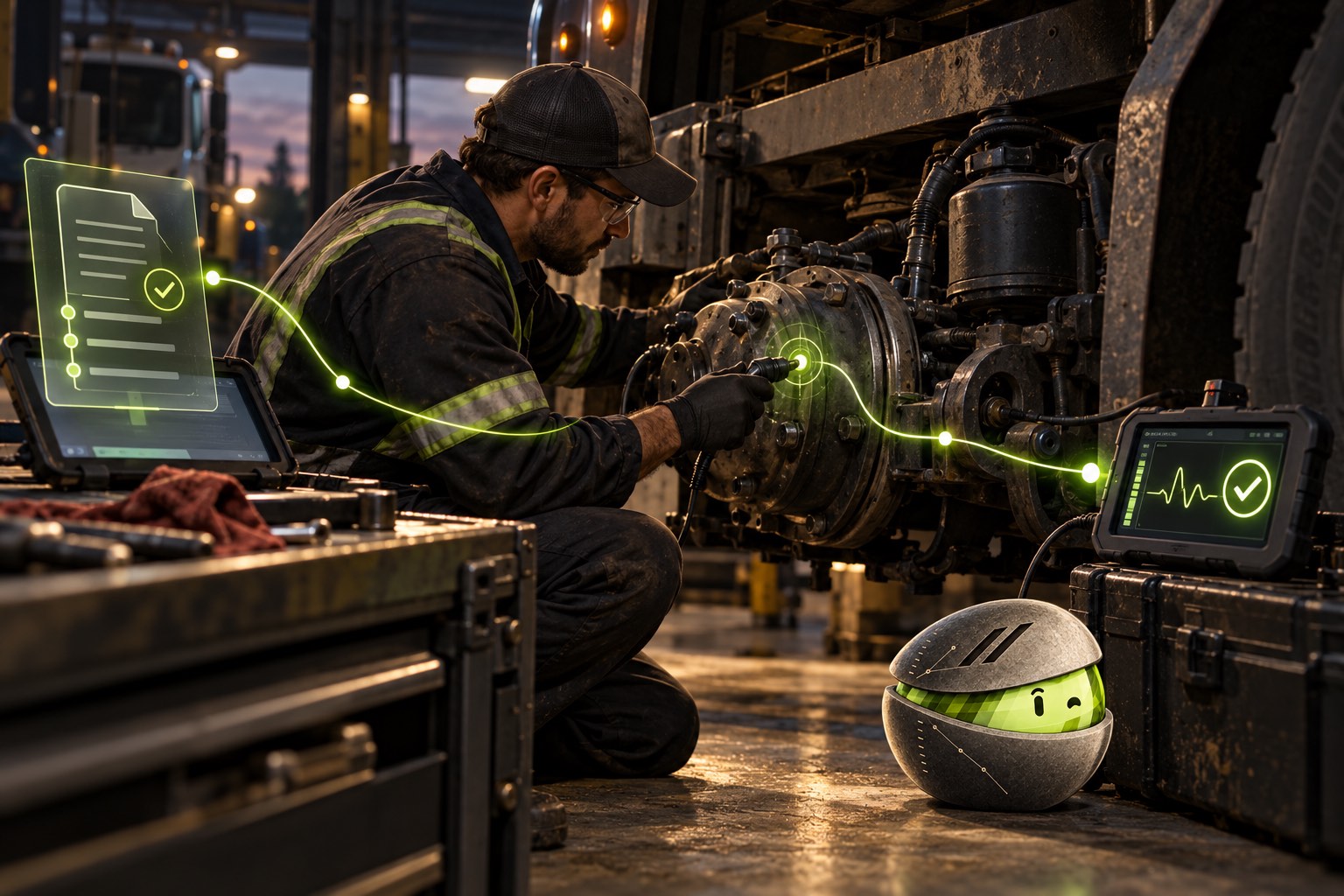
An AI system can detect a fault code, contact the driver, mark a vehicle out of service and open a work order.
That is not a small achievement.
It is also not the same as knowing the repair worked.
Motive made that distinction newly visible this week when it launched Agents for physical operations. The company says its software can watch operational signals and automatically initiate actions across safety, maintenance and compliance. In one example, an Agent interprets a vehicle fault, contacts the driver, opens a maintenance work order and removes the vehicle from service.
The industry is moving from dashboards that describe the world to systems that can intervene in it.
Now the harder question begins: what record tells the agent whether its intervention produced the right outcome?
Action closes a workflow. Verification closes the loop.
A work order records intent. It tells us that somebody decided a problem deserved attention.
A completed work order records a claim. It tells us that a task was marked done.
A verified outcome requires more.
Getting the diagnosis wrong has an immediate cost. Work Truck noted that for a small business relying on every available vehicle, an unnecessary out-of-service designation could disrupt an entire day’s schedule. The agent does not need to make a spectacular mistake to damage the operation. It only needs to be confidently wrong at the wrong moment.
Was the original fault actually removed? Did the equipment pass inspection? Did it return to service? Did the same symptom recur a week later? Was the first diagnosis correct, or did an experienced technician discover a different root cause once the machine was opened?
Those questions are easy to collapse into one green status box. Operationally, they are different events.
If an agent sees only the alert and the work order, it can learn how an organization routes activity. If it also sees the diagnosis, intervention, test result and later performance, it can begin to learn which actions solve which problems under which conditions.
That is the difference between automating choreography and building operational judgment.
The useful record has three layers.
Most industrial systems already preserve part of the story.
The first layer is the event: a fault code, vibration threshold, inspection finding, late purchase order or quality exception.
The second is the response: a call, escalation, work order, replacement part, revised schedule or technician visit.
The third is the outcome: the post-repair measurement, accepted inspection, successful restart, sustained operating period or later recurrence.
The first two layers are becoming easier to automate. The third remains fragmented.
It may live in a technician’s notes, a diagnostic tool, an inspection photograph, a customer sign-off, a machine log or a service history maintained by somebody else. Sometimes it exists only in the technician’s judgment: the vibration is gone, the sound is right, the pressure holds.
That fragmentation is not an edge case. It is the structure of real work.
Canada is building agents on top of industrial memory.
Motive is one signal. Aerium is another.
The Toronto company announced a US$2.5 million seed round this month for an AI platform aimed at industrial manufacturers and distributors. Its product connects information across systems and deploys agents into workflows such as quoting, procurement, production coordination and maintenance. Aerium’s public materials emphasize customer ownership of data and models, human approval for important decisions and a full audit trail.
Those are sensible foundations. They also make the next asset visible.
An audit trail can show what the system did. An outcome record shows whether it was right.
Many Canadian manufacturers, fleets, utilities and service businesses have accumulated both pieces, but rarely in one clean dataset. Their ERP records know what was ordered. Their maintenance systems know what was assigned. Their equipment knows what happened next. Their experienced people know why the first plan changed.
Connecting those records is not merely an integration problem. It is a new data asset.
The rights question arrives before the learning loop.
The moment an operational agent begins learning across actions and outcomes, ownership becomes practical rather than philosophical.
Who controls the fault history: the equipment owner, the telematics platform or the manufacturer? Who can reuse the technician’s explanation? Does a service provider have permission to use a customer’s repair history to improve a model? Can a software vendor train across customers, or only operate inside each customer’s environment? If a better system is created from years of frontline corrections, do the business and workers who produced that history participate in the value?
There is no universal answer. Contracts, privacy obligations, worker consent, trade secrets and sector rules will differ.
But the questions should be answered before years of outcome-linked evidence quietly become somebody else’s model advantage.
When the same vendor platform holds the fault, the work order and the repair history, it may also hold the cleanest version of the outcome record. The operator’s leverage is the contract: access, export, retention, model-training rights and control of derived data should be settled while the operator still has the ability to negotiate them.
Canadian industrial firms do not need to choose between keeping every record locked away and granting broad rights to every vendor that offers an AI feature. A more useful starting point is narrower:
- keep the underlying operational records under the company’s control;
- separate system operation from permission to train or commercialize;
- define which fields and derived records can move;
- preserve provenance from event through intervention to outcome;
- make external reuse opt-in, bounded and compensated where appropriate.
The terms are not paperwork around the product. They are part of the product.
The next valuable dataset may be a repair history with an answer.
AI agents will create more work orders, recommendations and automated interventions. That increases the value of knowing what happened afterward.
For an operator, the immediate benefit is better accountability. For an AI builder, it is training and evaluation evidence. For an archive owner, it may be the difference between a pile of old service records and a defensible corpus that links conditions, decisions and results.
The valuable unit is not the alert. It is not the instruction. It is not even the repair by itself.
It is the full episode:
what happened, what somebody did, what changed, and how they knew it worked.
The agent can open the work order.
The archive tells us whether the problem was solved.
Motive: Motive Launches Agents: AI that Acts Before Problems Start ↗, October 19, 2026.
Aerium: company platform and security materials ↗.
BetaKit: McKinsey alumni raise $2.5 million USD to build AI for industrial manufacturers ↗, October 16, 2026.
Work Truck: Can AI Agents Help Small Work Truck Fleets Do More With Less? ↗, October 20, 2026.
Company capabilities and performance statements are attributed to company-controlled sources and have not been independently verified. The distinction between workflow completion and verified outcomes is the author’s analysis.
Archive Signal works on operational archives, physical-AI data sourcing and outcome-linked records, and may benefit from related engagements.