
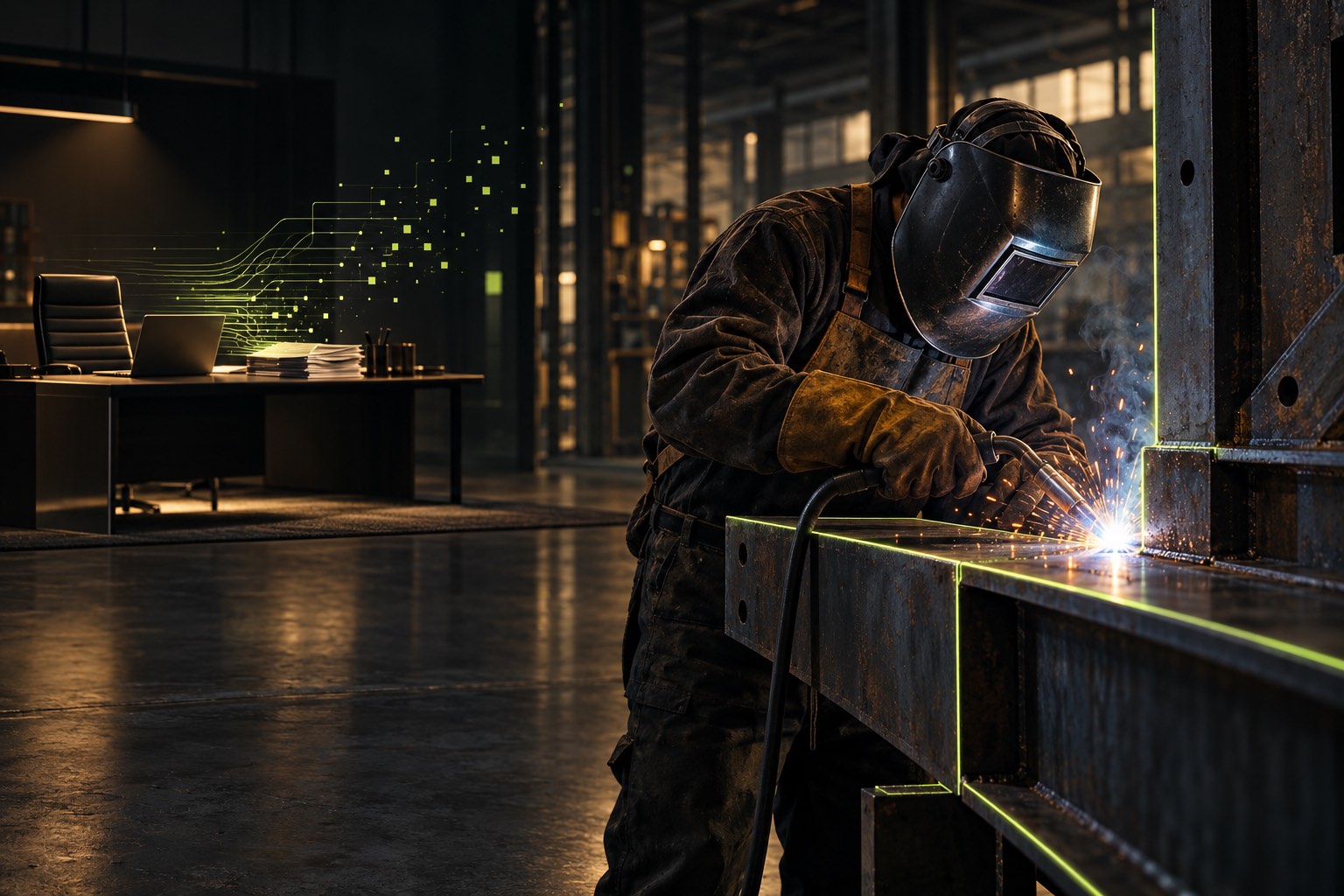
AI may automate the people who describe, approve and coordinate productive work before it can automate many of the people who physically perform it.
That possibility turns the conventional hierarchy of work upside down.
For decades, organizational rank, compensation and prestige have been treated as rough proxies for intelligence. The CEO sits at the top, so the CEO must possess the company’s most valuable knowledge. The welder, machinist, technician or operator is classified as labour: essential, perhaps, but supposedly easier to substitute.
AI is beginning to expose the weakness in that assumption.
The office has already recorded itself
Much of executive and managerial work already exists in machine-readable form. It moves through email, presentations, forecasts, reports, meeting transcripts, approvals, dashboards and plans. The work is linguistic, symbolic and heavily mediated by software.
That does not make leadership trivial. Authority, accountability, capital allocation, persuasion and political judgment still matter. Ownership can preserve a role even after many of its tasks become easier to reproduce. But a surprising amount of the apparatus surrounding leadership is exactly the kind of activity language models can observe, summarize and imitate.
The archive exists because the office has been recording itself for thirty years.
Physical skill has not
A skilled welder works inside a much larger action space. Material preparation, joint geometry, heat, angle, travel speed, sound, vibration, visibility, tool condition and safety interact continuously. The expert corrects for them in real time, often without translating the judgment into words.
The intelligence is embodied. It lives in perception, timing and touch. Most of it was never captured.
A manual can describe the procedure. A video can show the motion. Neither automatically contains the link between the conditions, the correction and the final result. To automate the work, a machine needs demonstrations, context, sensor data, failed attempts, verified outcomes and human judgment about what changed and why. It also needs hardware capable of acting on that knowledge in an unpredictable physical environment.
The CEO’s work left a digital exhaust trail. The welder’s best decisions may have disappeared the moment they were made.
What the interview reveals
This week I watched two conversations about the same emerging market from opposite ends of the supply chain.
In one, a data broker explained how companies can package operational archives for AI buyers. The conversation quickly moved toward search traffic, referral fees and brokers feeding other brokers. The business opportunity was framed as acquisition and arbitrage: find owners who do not know what their data is worth, route the opportunity and earn a cut.
In the other, micro1 founder Ali Ansari described the industrial demand behind that scramble. His company recruits experts, gathers human judgments and turns work into structured training environments. Ansari argued that models need continuously updated human know-how, and that useful training data must represent the full distribution of activity in the economy, including ordinary work.
One example in the interview gave the game away. The highest-ranking person in an institution may not be the person best able to teach a specific workflow. A chief executive or general counsel may approve the work without being the person who can perform it best. The useful teacher is often the person closest to the task.
That is a very different map of where intelligence lives inside a company.
The replacement hierarchy may be upside down
The familiar automation story reassures the professional class. Machines replace repetitive physical labour, while educated managers move upward into judgment, strategy and creativity.
Generative AI challenges that sequence. Language, analysis, summarization, planning and administrative coordination became tractable before general-purpose robotics. The work with the highest status may not be the work with the strongest technical moat.
This does not mean every CEO disappears. A corporation still needs legal authority, accountability and someone empowered to make consequential decisions. It does mean we should separate the office from the tasks performed inside it. A role can remain institutionally important while much of its daily work becomes machine-legible.
The welder has the opposite problem. The role may carry less institutional power, yet the underlying task remains difficult to reproduce because its intelligence is dispersed across the body, the tool, the material and the environment.
The real dividing line
The important distinction is not white collar versus blue collar, or smart work versus repetitive work. It is legible versus embodied, recorded versus uncaptured, and reproducible in language versus dependent on real-world perception and action.
AI does not care about the org chart. It cares whether a judgment can be observed, structured, verified and reproduced.
That changes how we should value company knowledge. The executive archive may contain useful decisions, but it is already dense with language and documentation. The operational frontier is often farther down the hierarchy, where the work is richest and the record is thinnest.
The person traditionally classified as labour may possess the scarcer intelligence.
What they may actually fear
The discomfort is not only that AI could eliminate jobs. It is that AI could expose how loosely organizational status has tracked informational value.
A manager can be expensive because the institution gives the role authority, not because every task inside the role is technically difficult. A tradesperson can be underpriced because the institution treats embodied judgment as labour, even when that judgment took decades to acquire and cannot be recovered from the company’s files.
Once AI buyers begin asking who can actually teach the workflow, prestige becomes a weak signal. The model does not need the most senior person in the building. It needs the person who notices the defect, makes the correction and can tell whether the result will hold.
The asset closest to the work
This is where the argument becomes practical for Archive Signal.
The scarce asset is not simply stored files. It is contextual human judgment: what happened, what the worker noticed, what action followed, what changed and whether the outcome was accepted. Some of that evidence already exists in maintenance histories, inspection records, job photographs, quality reports, service tickets and operating logs. Much of it still disappears when the shift ends.
The companies that learn to preserve that judgment on clear terms will own something more defensible than a pile of documents. They will own a record of how the physical economy actually works.
The question for leaders is therefore uncomfortable but useful: whose work is easiest to describe, and whose knowledge would be impossible to reconstruct if that person walked out tomorrow?
The answer may not follow the org chart.
Ali Ansari interview: AI Will Always Need New Data to Stay Aligned With Humans ↗.
Data broker interview: A Data Broker Explains Why OpenAI Is Begging to Buy Your Company ↗.
The interviews are cited for the speakers’ views; the replacement-hierarchy argument is my own. Archive Signal develops methods to preserve and responsibly license operational knowledge and may benefit from related engagements.