
FIELDKIT
Expert work.
Captured with context.
FIELDKIT is Archive Signal’s planned field-capture infrastructure for physical AI. It is designed to connect skilled actions, equipment state and verified outcomes into structured, rights-cleared records.
Explore the next stage ↗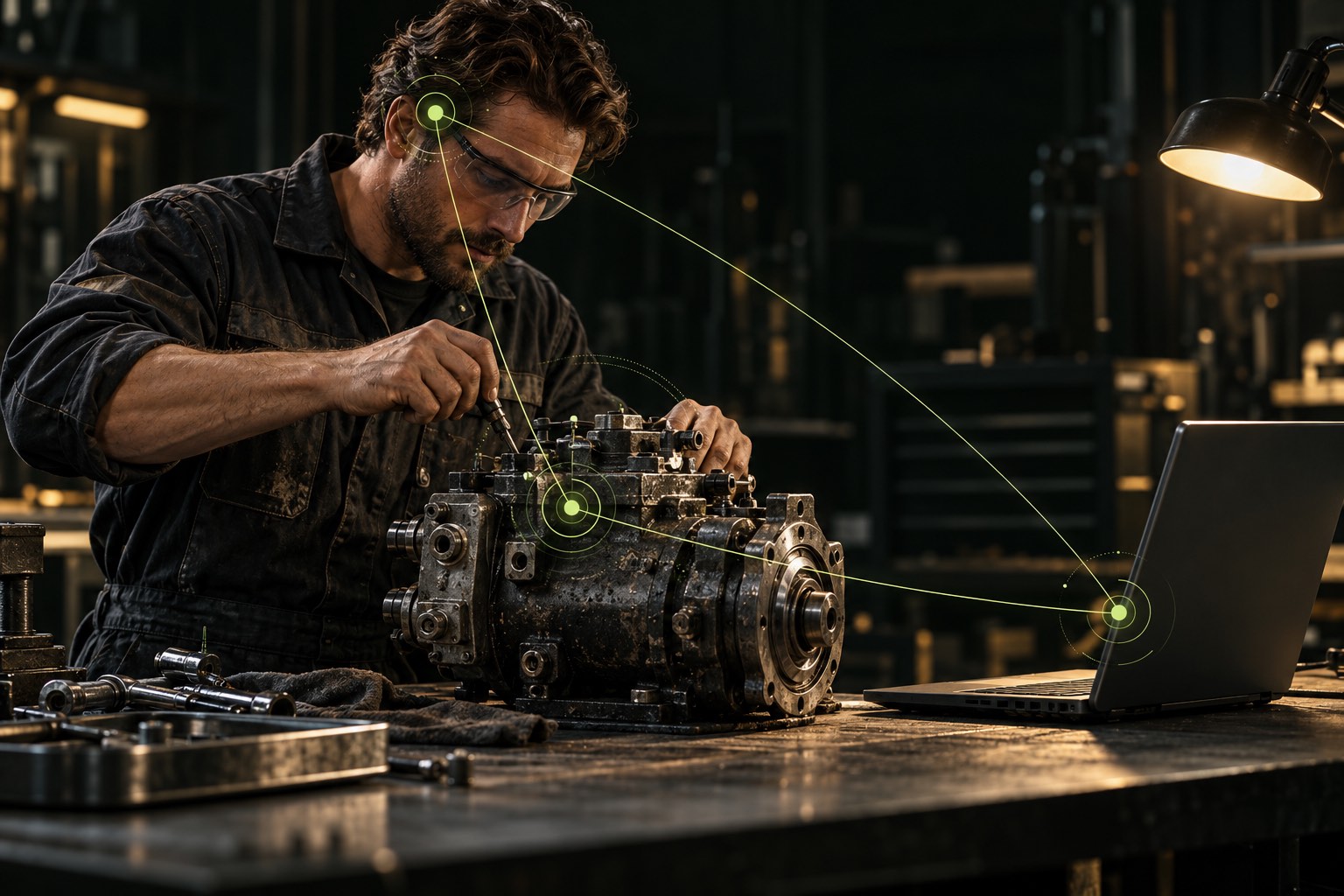
Built around the people
doing the work
The goal is not simply to record movement. It is to preserve the judgment behind the work: what an expert noticed, what they tried, and how they confirmed the result.
The proposed participation model starts with explicit consent, agreed recording boundaries and compensation for participating workers and businesses. Qualifying licensing arrangements may also provide participation in the value created.
Initial focus areas include heavy equipment, HVAC and marine mechanical work, beginning on Vancouver Island.
From useful footage
to useful evidence
Development is informed by requirements discussions in the physical-AI data market. We are evaluating synchronized first-person capture, equipment context and outcome documentation, with collection and delivery requirements defined around each brief.
Field testing must establish whether those records are reliable, useful to model builders and economical to produce.
Why this matters now
Commercial capture programs and research are establishing a market for learning from human experience. Mecka announced a $60 million Series B in October 2026, while Mercor publicly offers paid workplace-video collection for robotics training.
Nature Will reports pretraining Natura-1 on more than one million hours of egocentric human experience, combining video with reconstructed motion and task annotations. Across a training range of roughly 44,000 to one million hours, it reports a 67.7% reduction in robot-action prediction mean squared error on held-out robot data using teacher forcing. This is a prediction-error result—not a 67.7% increase in real-world task success.
The company also identifies complex activities and specialized settings as underrepresented in large-scale collection. FIELDKIT’s proposed focus on skilled diagnosis, corrections and verified outcomes addresses that opportunity; its usefulness still needs to be tested with buyers.
These company-reported developments support the broader opportunity. They do not validate FIELDKIT’s implementation or imply any affiliation or endorsement.
Build the evidence.
Then build the scale.
Architecture, specifications and deployment costing are developed. The next stage requires capital, technical collaborators and suitable pilot sites to validate capture quality, participant experience and buyer usefulness before scaling.
Discuss FIELDKIT ↗Explore ToolTag, our other development project ↗