
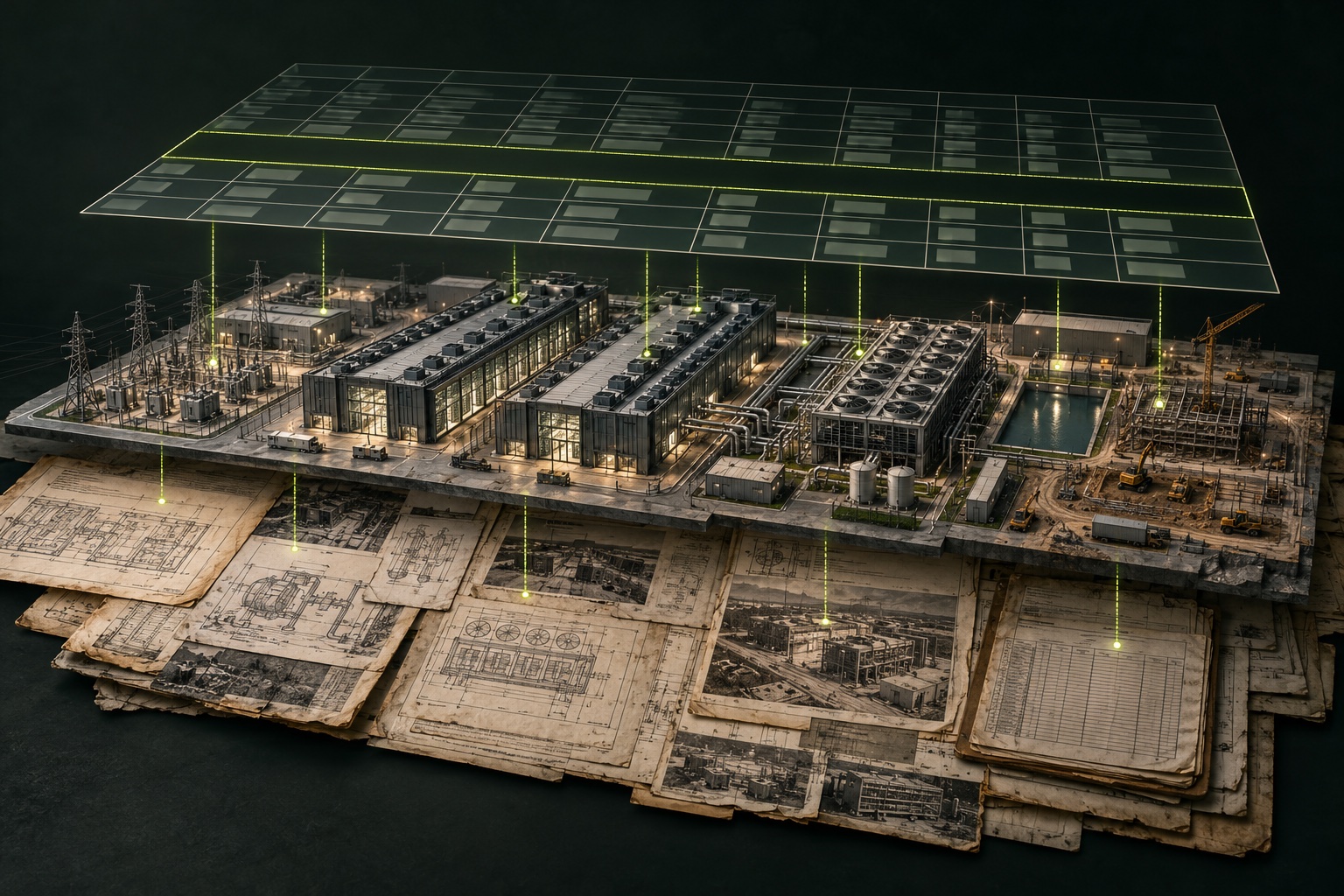
Shaun Maguire's SpaceX model has a row for almost everything: revenue by segment, operating income, capex per gigawatt, revenue per gigawatt, Starship flights, megawatts per launch. It has no row for the operating knowledge of the people who have to deliver the gigawatts.
That omission needs to be stated carefully, because for SpaceX itself the obvious version of the argument fails. SpaceX is the counterexample. It generates its own flight telemetry, anomaly records, inspection histories, and turnaround data, keeps them, and learns from them faster than any launch company in history. Its own learning loop is closed, and that is a large part of why it can plausibly attempt what the model describes.
But the model does not stop at SpaceX's fence line. It assumes roughly 21 gigawatts of terrestrial compute by the end of 2028, plus orbital compute, plus the power generation, grid interconnection, substations, cooling, construction, chip supply, and maintenance that 21 gigawatts drags behind it. Much of that delivery sits with utilities, engineering and construction firms, equipment plants, and operators. Their operating knowledge is not SpaceX's, it is not in the model, and it is not priced anywhere in the businesses that hold it.
That is the missing row. Not SpaceX's records. Everyone else's.
The model, compressed
Maguire, a Sequoia partner, models SpaceX revenue at approximately $51.5 billion in 2026, $273.8 billion in 2027, and $731.1 billion in 2028, with operating income reaching $483.9 billion in 2028. The growth is not the launch business. Space and connectivity together are only about 14.5% of 2028 revenue. The segment the model labels SI contributes $625.2 billion, and terrestrial compute alone contributes $569 billion, on capacity rising to 21 gigawatts at roughly $40 billion of annual revenue per gigawatt. Starship flights rise from 2 in 2026 to 250 in 2028. Capex totals roughly $747 billion across the three years, and the model burns about $200 billion of cash before turning positive in 2028. Maguire disclosed Sequoia's major stake, called the numbers insane, and flagged wide error bars: an invested bull's upside construction, to be read as one.
Context cuts in both directions. Analyst consensus for 2027 revenue sits near $110 billion, well under half of Maguire's figure. But consensus has been chasing this company from below: SpaceX guided first-quarter 2027 revenue to $33–37 billion against a $22.2 billion consensus, and Maguire's $36.3 billion sits inside the company's own range. Bernstein, no skeptic, forecasts $424 billion for 2028, on about 20 gigawatts, roughly 58% of Maguire's revenue on nearly the same physical capacity. The disagreement is not mainly about gigawatts. It is about what a gigawatt earns.
Dan Gray's response to the model debate supplies the reading rule: a model is an assumption map, not a precision instrument, and it should be debated at the level of its assumptions. Correct, with one addition. The assumptions are not independent. In a spreadsheet the rows are separable; in the physical system they are coupled. If power, chips, construction, or financing bind, capacity, revenue per gigawatt, and cash generation move together, so correlated error bars compound rather than diversify.
The utility critique, and the payback answer
The strongest counter-frame came from Investing in AI: the Valley prices AI like software, Wall Street is learning to price it like a utility. Its evidence is the hyperscalers, not SpaceX: the big four guiding to roughly $720–745 billion of combined 2026 capex, Alphabet alone at $195–205 billion, second-quarter cash capex at 115% of operating cash flow for Alphabet and 119% for Amazon, GPUs depreciated over five or six years against a competitive life of maybe two or three, and the price of a fixed level of model performance falling by a median factor of about 50 per year.
Applied to SpaceX today, though, the critique runs into a reported fact: on its third-quarter call, SpaceX said new compute deployments are paying back in under a year at current pricing, slightly above the high end of its previously discussed $30–50 per watt range. Musk floated a possible six-month payback next year, explicitly as a possibility, not a prediction.
That claim deserves a direct answer, because it is the strongest single fact against the depreciation argument. If a deployment recovers its capital in twelve months, the Burry-style objection loses much of its force for those deployments even if the hardware is obsolete in three years. A fast payback converts the depreciation debate from "will this asset earn its cost back" into "how much surplus does it generate after it has."
But a payback period is a spot fact, not a through-cycle law, and three qualifications matter. First, it is measured at today's scarcity pricing, and SpaceX's deliberately short contracts preserve repricing in both directions. Second, scarcity rent is highest on the first gigawatts, and the open question is whether gigawatt eighteen pays back like gigawatt three once SpaceX's own additional ten gigawatts in 2027 and everyone else's capacity reach the same market. Third, payback is a deployment-level cash measure, not a fleet-level return once refresh capex, financing, and power infrastructure are charged against the same revenue. Bernstein's $424 billion is what a friendly version of that caution looks like: similar steel, much less revenue per unit of it.
So the honest position is both. The utility critique describes the regime risk correctly. The payback claim shows SpaceX is, at current prices, beating that regime. What settles it is not rhetoric. It is realized revenue and margin per utilized gigawatt on contract renewals, reported against full-cycle capex.
The missing row, one layer out
Return to the fence line.
Inside it, SpaceX's learning compounds because the record is proprietary, retained, and joined to outcomes. A booster flies, sensors report, an anomaly is investigated, a fix is verified on the next flight. That loop is the company's deepest moat, and the model is right to assume it continues.
Outside it, the buildout depends on a delivery system whose learning is fragmented across thousands of firms. Grid interconnection studies and the switching, protection, and substation work behind them. Generation and cooling plants built, commissioned, and maintained by contractors and operators. Equipment manufactured in plants whose ramp problems, defect patterns, and repair histories live in their own systems. Even Terafab, the chip venture meant to pull the most critical input inside the fence, is described in SpaceX's own S-1, as reported, as a general framework whose specific projects and terms remain to be negotiated. The fence does not yet cover the fab either.
None of this makes the buildout impossible. It makes its pace dependent on knowledge the model treats as a free input. When interconnection slips, when a commissioning team hits the failure mode that a predecessor documented in a system nobody can search, when a plant's ramp stalls on a problem its own archive already solved once, the cost shows up in Maguire's spreadsheet as a delayed gigawatt or a higher capex line. The cause sits in a record, in someone else's filing system, priced at zero.
We made a version of this argument last week about recursive self-improvement: automate the components, and the regress terminates in the component makers' records. The same regress runs here. Scale the data centers, and the binding knowledge is the builders' and operators' records. There is no layer of the physical stack where the dependency on recorded, outcome-joined experience disappears. There is only a layer where someone has assembled that record, or has not.
What to watch
- Realized revenue per utilized gigawatt, on renewals as well as first contracts, separated from nameplate capacity.
- Payback at the margin: whether deployments later in the buildout still recover capital in under a year as industry supply rises.
- Full-cycle capex per gigawatt, including refresh, power infrastructure, and financing, against accounting depreciation.
- Delivery evidence: interconnection timelines, commissioning speed, and construction slippage, the places where third-party knowledge binds first.
- Constraint ownership: who holds the input that stays scarce after model and compute prices fall.
Why Archive Signal
Archive Signal does not need to settle whether 2028 revenue is $424 billion or $731 billion.
If Maguire is broadly right, AI becomes the largest industrial buildout in history, and its pace is set partly by operating knowledge held outside the companies financing it. If the utility critique is right, models and compute commoditize, and value migrates to scarce inputs, proprietary data, and embedded workflows. The conclusion survives both outcomes: as intelligence gets cheaper to invoke, verified experience gets harder to substitute, and much of that experience sits in records their owners have never priced.
The useful questions about such a record are not how many terabytes it contains. They are whether it is proprietary, rights-cleared, joined to outcomes, difficult to reproduce, and still being generated by a live workflow. Those properties decide whether a business's history remains an asset when the market reprices everything around it.
Yesterday's records. Tomorrow's signal.
If your organization holds years of operating, inspection, service, or customer-outcome records, the question is not whether AI companies want "data" in general. It is whether your history is one of the inputs the next buildout silently assumes, and whether it will still exist, intact and usable, when that assumption comes due.
Drew Clement is building Archive Signal, rights-cleared, outcome-linked physical data. The answer keys AI trains against.
Sources: Shaun Maguire, "People don't understand SpaceX", X, October 30, 2026, and the accompanying model; Dan Gray, response to the model discussion, X, November 1, 2026; Investing in AI, "Silicon Valley Is Wrong About AI, And Wall Street Is Right", November 1, 2026; Dealroom, "Sequoia's Shaun Maguire models SpaceX revenue at $274B in 2027 and $731B in 2028", October 30, 2026; Invezz, "SpaceX stock rises, why analysts see more upside for the stock", October 27, 2026; The Motley Fool, "Did SpaceX Just Save CoreWeave, Nebius, and the Neocloud Sector?", October 21, 2026.
Disclosure and method: Figures attributed to Maguire are projections from his model, not reported SpaceX results. Payback and pricing figures are company statements reported from SpaceX's third-quarter 2026 call. Maguire disclosed that Sequoia is a major SpaceX shareholder and that he is biased toward the company. Investing in AI disclosed a business interest in routing work across models. Archive Signal works with owners and buyers of data assets. This article is analysis, not investment advice.