
Sam Altman said something this week that deserves more than the day of headlines it got.
On John Collison's Cheeky Pint podcast, published October 29, the conversation turned to recursive self-improvement, the idea of AI that does AI research and compounds itself. Altman moved it somewhere else. He said there is relatively little talk about self-replicating data centers: using AI to control robots that run fabs, build turbines and solar panels, and build data centers. He said OpenAI is learning to build its own data centers, that its robotics program will be pointed at "making lots of data centers," and that the idea is "within grasp."
Coverage notes that he gave no timeline, data-center count or budget, so this is an ambition, not a schedule. Still, take it seriously for a minute, because it is one of the most consequential versions of the AI story anyone at that level has said out loud. Then ask a question I did not see in the coverage: what do the robots learn from?
The recursion is physical, and physical skill is data
The software version of recursive self-improvement has a clean loop. A model writes code, the code helps train a better model, the better model writes better code. The inputs are text and compute, both of which the labs can scale.
The physical version has no such loop yet. A robot that runs a fab has to handle the fab's thousand undocumented exceptions: the tool that drifts, the part that arrives out of spec, the fix the senior technician applies without writing down why. A robot that erects a turbine or commissions a data center faces weather, tolerances, sequencing and failure, in an environment that was never instrumented for its benefit.
This is Moravec's paradox at industrial scale. The things humans find hardest, abstract reasoning, are the ones machines acquired first. The things humans find effortless, sensorimotor judgment built over years of practice, are the expensive ones. You cannot download a commissioning engineer's judgment. You can only train on records of it being exercised.
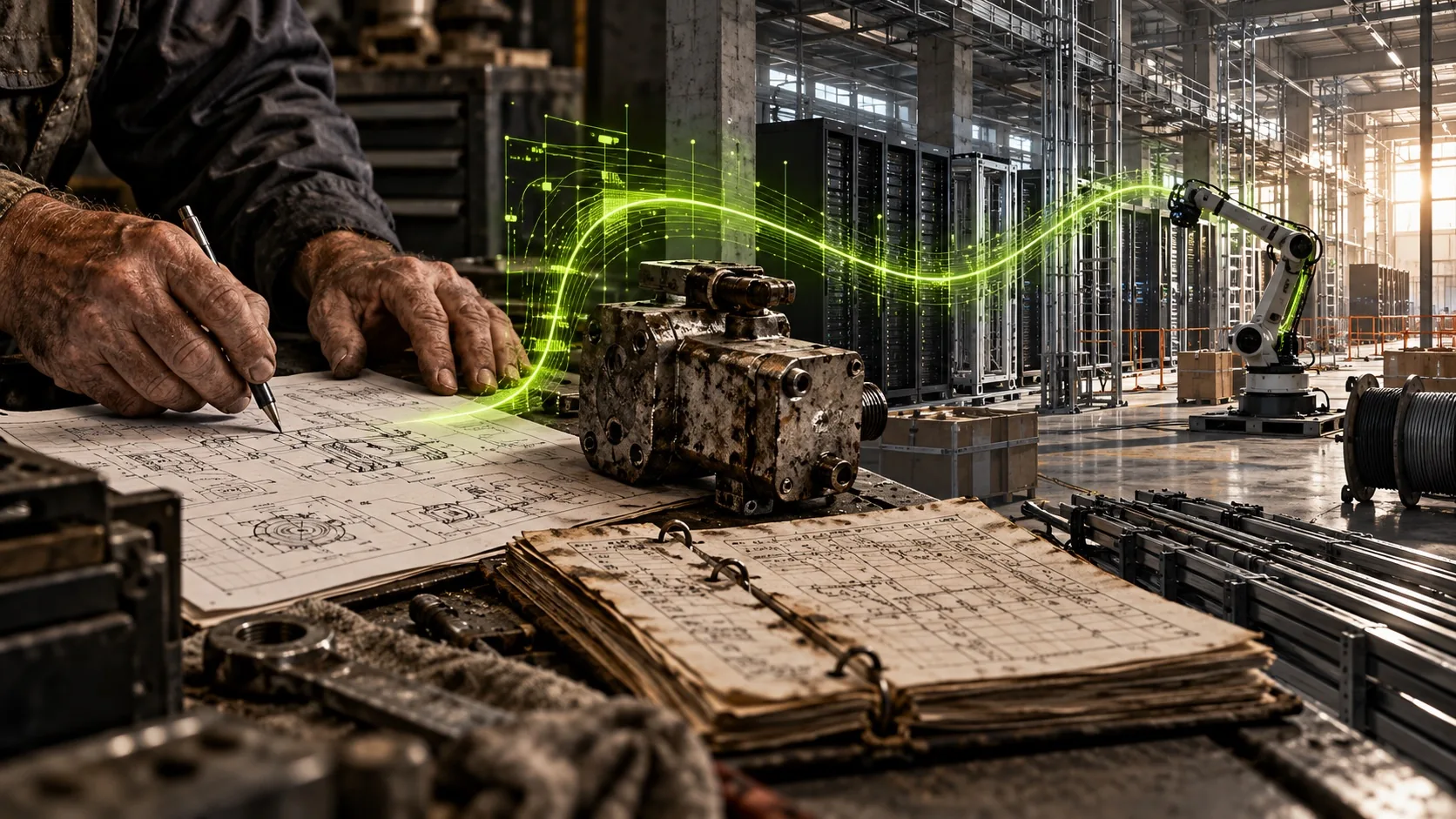
So I think one of the binding inputs to a self-replicating data center is not the robots or the models. It is a corpus: the recorded history of skilled people building and running exactly these facilities, with the outcomes attached.
That corpus exists. It is mostly not where the labs are looking
Every fab ramp, every turbine erection, every data center build and retrofit generated an operational record. Process logs and tool histories. Work orders and commissioning reports. Failure records, root-cause analyses, repair histories, and as-built documentation that shows where the design met reality and lost. Decades of it, held by the contractors, operators and utilities that build the physical world.
Almost none of it is on the internet. It sits in private systems, usually valued at nothing by the firms holding it, spread across thousands of owners. It is also perishable: retention schedules delete it, systems get replaced, and companies wind down and take their records with them.
The standard industry answer to robot data is different. Hire demonstrators and instrument a controlled space, then generate clean demonstrations at lab scale. But a demonstration in a lab is not experience on a working site. A paid collector in a controlled space produces few failures at industrial rates, little consequence and no outcome to join the action to. The record has the motion and less of the meaning. That is why our focus is on records and captures from real working sites, with outcomes attached, and not on lab demonstrations.
The strongest objection
Once robots work on real sites, they will generate their own data. Learning from trial and error is how the software side compounds, and a deployed robot does not need anyone digging through twenty-year-old work orders. Simulation and synthetic data will also carry much of the load. The people building them say so.
I think that objection is right about the long run and incomplete about the start. A robot has to be competent enough to be allowed onto a site before it can learn from one. Mistakes in a fab or on a build site are expensive, so someone has to verify that the machine's actions were correct. Simulators have to be checked against what really happens.
Cold start, verification and grounding for simulation are the jobs where recorded human work with outcomes earns its keep. It may matter less once the flywheel turns. How much it matters, and for how long, is something buyers will decide.
Every layer needs a record
Collison pushed on the obvious objection: data centers are not labor-bottlenecked, they are permitting-bottlenecked and component-bottlenecked. Altman's answer was that robots could make more components.
Follow that one step further. Components are manufactured in plants, by people, whose work is recorded in the same class of operational systems as the fab and the build site. Automating component production needs the component makers' records. Automating the fabs needs the fab operators' records. At every layer, the first generation of automation seems to lead back to the same place: recorded human work, with outcomes, held by firms that may not think of it as an asset.
Why the labs may not solve this themselves
Labs are organized to generate data forward: instrument a product, collect the exhaust, train on it. Acquiring data backward is a different job. It means finding the owners of twenty-year-old operational records, establishing who holds the rights, preserving the files before the retention schedule does its work, and joining systems that were never designed to be joined.
In practice, labs buy a lot of data through vendors. Anthropic’s S-1 reports a US$251 million year-over-year increase in vendor costs for data quality and performance evaluation during the six months ended June 30, 2026. That is an increase, not a total spending figure, and the filing does not identify the mix of services behind it. To my knowledge, most of that market sells expert labor and evaluations, not twenty-year-old operational archives. That gap is where I think the opportunity is.
Altman may well be right about the destination. "Within grasp" is an ambition without a stated timeline, so I will not call it wrong. But the pace of it may depend less on the robots than on whether anyone assembles the records of how these things were built the first time, by hand, by people who knew what they were doing.
If you run a firm that builds, operates or maintains physical infrastructure: what do you suppose your last twenty years of records are worth, and to whom? I would genuinely like to hear the answers people give.
Drew Clement is building Archive Signal: rights-cleared, outcome-linked physical data. The answer keys AI trains against.
Sources and perspective
- Cheeky Pint, John Collison interviews Sam Altman, published October 29, 2026. Altman's remarks are quoted from the published transcript.
- The Next Web, "Sam Altman says OpenAI will point its robots at building data centres." Coverage notes that no timeline, count or budget was given.
- Slator, "What Anthropic's IPO Prospectus Says About the AI Data Opportunity and Localization Risks." The vendor-cost increase was checked against Anthropic’s Form S-1, page 150, in Management’s Discussion and Analysis, under Other Operating and Administrative. It compares the six months ended June 30, 2026 with the corresponding 2025 period; it does not disclose total spending or establish purchases of operational archives.
Claims about what robots will be able to do are ambitions and have not been independently verified. The argument about records is my own analysis. Archive Signal works on operational archives and physical-AI data sourcing and could benefit if markets for those develop. I have no relationship with OpenAI or Anthropic.