
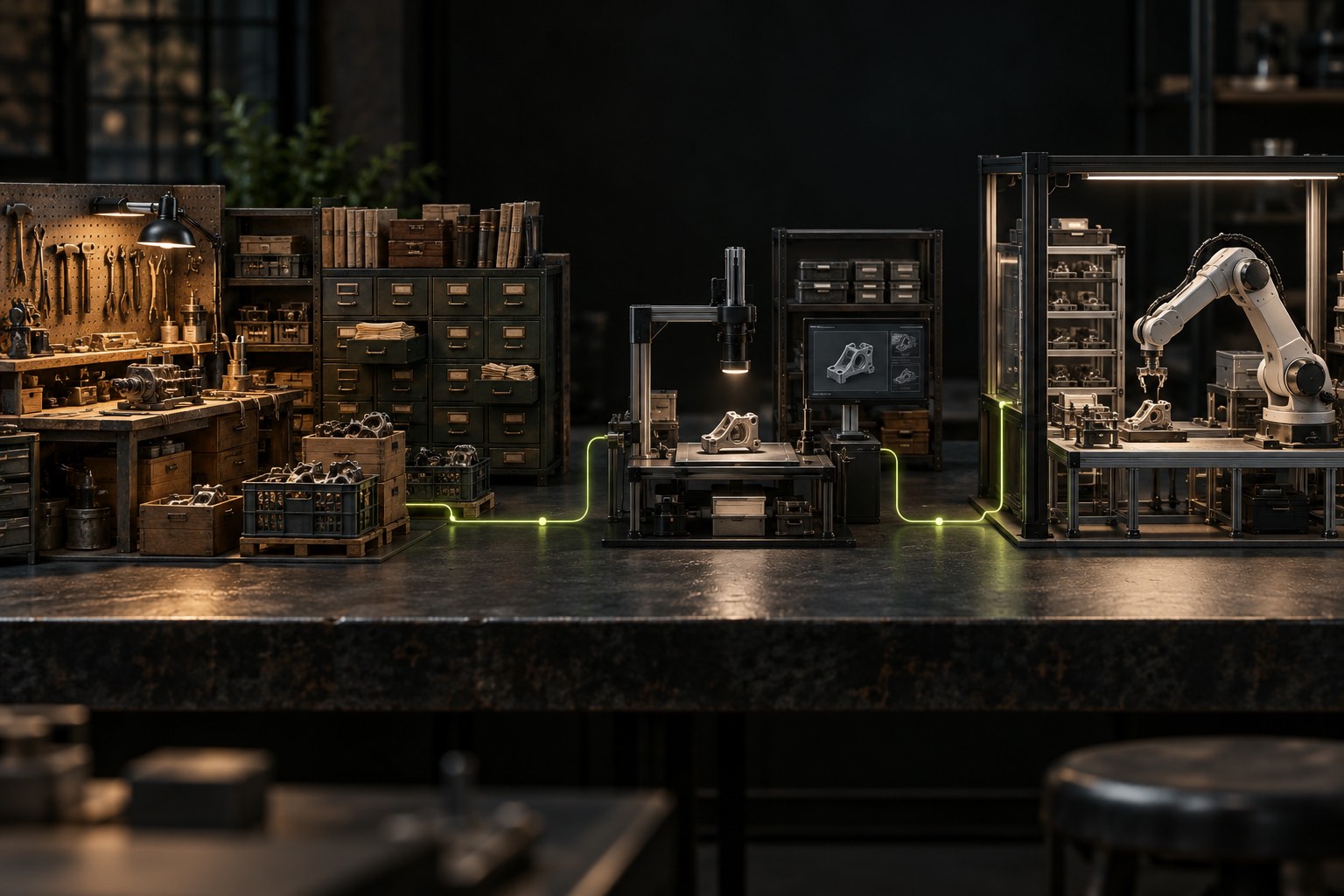
Michelle Sun’s The Economics of Robot Data asks an important question: how much of the robotics-data opportunity lies beyond selling datasets?
Her argument is that collection builds the equipment, operating discipline and customer relationships needed to move into recurring evaluation and deployment services.
There’s a further question underneath that business model: who supplies the experience those services depend on?
Building a reliable collection operation is difficult. Securing access to work worth collecting is a different problem—and potentially a different business.
The raw material is not interchangeable
Language models benefited from an enormous body of human expression already recorded in digital form. Robotics inherits a less convenient starting point.
Much of the physical experience a model might need was never recorded. Some exists on video, but without the measurements or action labels required for a particular task. Other knowledge survives in service histories, inspection records and the judgment of people still doing the work.
Those sources are not substitutes for one another. A maintenance archive is not automatically robot-control data. A clear video is not automatically a usable demonstration. But each may contain evidence that a particular buyer cannot efficiently create internally.
That is where supply becomes more than a question of recording capacity.
Some experience is commissioned. Some must be found.
Purpose-built demonstrations are essential. They let collectors control the equipment, repeat tasks and produce consistent measurements. Better hardware and processing can improve their economics.
Sun illustrates how much utilization and quality matter: in her hypothetical example, operator labor alone ranges from $62.50 to $166.67 per accepted trajectory-hour as recording time and acceptance rates change. Hardware, premises, separate processing staff and overhead come on top.
There is another kind of supply: experience accumulated through businesses operating over time.
Factory records linked to defects. HVAC work orders paired with repair results. Warranty claims with documented root causes. Construction inspections connected to rework and sign-off.
Those records are not necessarily complete, licensable or useful. Finding out is part of the work.
But nobody can go back and manufacture the same twenty years of a master electrician’s panel diagnostics. You find the archive—or arrange to capture the expertise while it is still available.
Both require relationships, permission and an understanding of what the buyer needs.
Access is only the beginning
This is not a claim that collection companies lack sophistication.
Mecka, for example, describes an operation spanning capture hardware, motion reconstruction, quality infrastructure and robot deployment. These are substantial technical capabilities, not simply cameras handed to gig workers.
The point is that even excellent infrastructure needs access to the right experience.
A collector can reproduce a familiar task under controlled conditions. Reproducing an intermittent fault on aging equipment, diagnosed by someone who has encountered its variations for decades, is a different proposition.
The difficulty may be finding the practitioner, gaining permission at the site, waiting for the event and connecting the intervention to a verified result.
That work is origination. It determines which experiences become available to the collection pipeline in the first place.
Scarcity has to survive the buyer’s test
It is tempting to assume that rare experience must be valuable. It does not follow.
A buyer may need synchronized measurements that an archive never captured. The relevant outcome may be impossible to verify. Privacy restrictions or third-party rights may prevent the intended use. Cleaning and delivery may cost more than anyone will pay.
The commercial test is therefore more demanding than finding something unusual:
- Does it address a specific training or evaluation need?
- Does it contain the signals and context required?
- Can the relevant outcomes be checked?
- Can the necessary rights be granted?
- Can it be delivered at economics that work for both sides?
A source becomes defensible when those conditions hold—not merely because someone has exclusive access to a folder.
The supply chain is part of the product
This is where Archive Signal is focusing: finding overlooked operational records and exploring capture around skilled work, then working backward from buyer requirements to determine what is worth pursuing.
That does not replace collection, annotation or evaluation. It needs them.
The opportunity is to connect businesses and practitioners who hold scarce experience with teams capable of turning it into useful learning—and to establish permissions and economics that make participation worthwhile.
As collection methods improve, some demonstrations may become easier and cheaper to reproduce. A particular operating history, expert network or stream of difficult real-world events may remain harder to access.
The durable business will need both: reliable production and a reason its supply cannot simply be replaced.
The camera isn’t the dataset. The collection pipeline isn’t the whole supply chain, either.
This note responds to Michelle Sun’s The Economics of Robot Data: Building the Scale AI of Robotics ↗. The labor-cost example is hypothetical, not an all-in market price. Mecka’s capabilities are described in its October 7, 2026 announcement ↗ and are company-reported.
Commercial interest: Drew Clement is the founder of Archive Signal, which is developing data-origination and capture opportunities. This argument does not claim established buyer demand, completed transactions or validated dataset economics.