
Several posts and announcements I read today described different parts of the same market. A data vendor published his call notes and put two once-hot categories in the not-selling column. Mercor raised three quarters of a billion dollars while making a larger argument about enterprise evaluations and post-training. A startup described how it turns production agent behaviour into evaluations and training environments. And a researcher explained, in technical language, what that next layer needs.
Read separately, they are posts. Read together, they suggest a sorting event. The buyers I am hearing from are asking less about how many files exist and more about what those files can prove.
The graduation note asked what buyers need next. The inventory note asked what remains available. This is the next question: what makes a record trustworthy enough to become the standard a model is measured against?
An operating hypothesis, in five parts.
1. Abundance became a warning, not a bargain
The call notes, from Kale Panoho at Tacit, are a useful sample because they are unguarded. What his buyers asked for last week: tutoring data, long clinical conversations, one-off wet-lab datasets, data in niches the buyers do not serve themselves. What is not moving: large marketing CRM databases, and CAD and SolidWorks files, which he says were selling at high volumes two weeks ago and have since declined significantly, “as the supply has become abundant.”
Sit with that mechanism. Abundance can change what the next file is worth. It can also change what a buyer is willing to take on trust.
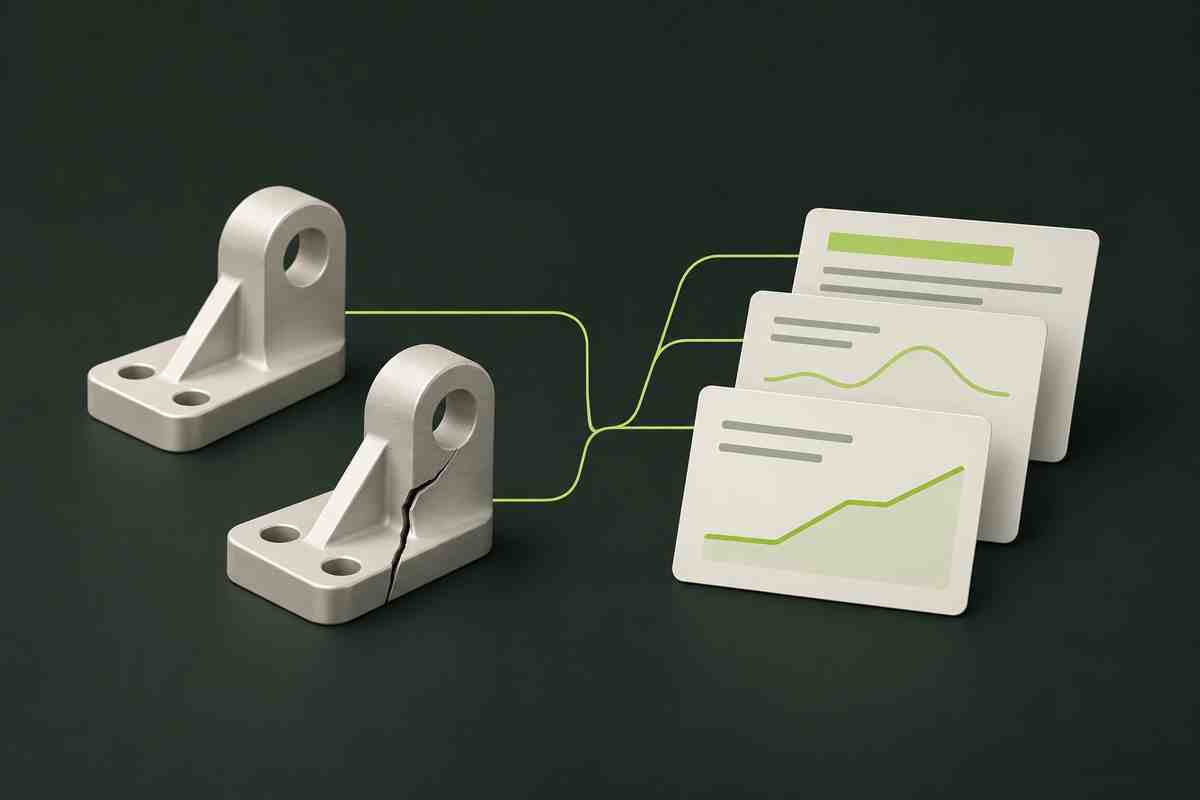
A flood of CAD files does not establish synthetic origin. It could include newly surfaced archives, duplicates or material whose marginal usefulness has fallen. But in a market where plausible files can be generated as well as collected, origin becomes a question the buyer has to resolve. My concern is that some of the flood is synthetic supply presented as something else. The files themselves cannot settle it.
Marketing records offer a related warning. A creator with 1.2 million customer records reported being unable to find a buyer. Whatever else limited that archive, volume alone did not close the deal.
2. Some deals now die on provenance before price is discussed
In October I was pitched a library of ten thousand human-drawn engineering parts. It was a good pitch. The files fell apart the moment anyone checked how they had actually been made. A buyer told me this week that his CAD deals keep dying on provenance.
That sentence captures a screen that comes before negotiation. Can this archive prove what it claims to be? Who made it. When. Under what rights. With what revision history. Whether the things it describes were ever actually built, sold or used, and what happened when they were.
In the conversations I am having, provenance is moving from a compliance item near the end of a checklist toward the first screen. A plausible-looking file can fail there before its price matters.
Working records accumulated for other reasons may carry unusually useful corroboration: authors, timestamps, revisions, orders, inspections and outcomes that can be checked against one another. A real operating history still needs diligence. Those records do not automatically establish clear rights, authenticity or training value. They give a buyer something more substantial to investigate than a claim attached to a folder.
When I put the tier argument to the author of those call notes today, he added the caveat himself, in public: a rare dataset with good records, annotation and history will still likely improve a model. Records, annotation, history. He was describing evidence about the data, not simply more of it.
3. The next layer needs failure
The second sorting question is stranger, and for owners it matters more. What does the archive preserve about the attempts that did not work?
Hannah Xu's summary of lab and vendor conversations this week put it plainly: labs pay most for data on what their models get wrong, while routine volume has become cheaper. That reported observation fits the product Convergent describes: using production agent behaviour to build evaluations and environments, then improve the agent.
A technical post by Avi Desai at ComprehensionAI today explained why that layer needs more than successful demonstrations. As systems train inside professional workflows, a valuable artefact is the grader: the rule or test that tells the training system whether an agent did the job correctly.
A successful demonstration shows one valid route. By itself, it may not expose the shortcuts, detours and plausible-looking failures an agent will produce. Desai's prescription is to gather alternative valid solutions and plausible failures alongside the reference trace, so the grader can be tested before it is trusted as a reward.
Translate that into records an owner might hold. A sales archive that keeps only its wins preserves less of the decision environment than one that also keeps its losses. A support history with resolved and unresolved cases, a workshop record with repairs that worked and repairs that came back, an operating history with the failures left in: each may help test whether an evaluation recognises a useful distinction.
An unsuccessful business outcome is not automatically an agent error. A sound sales decision can still end in a loss; a repair can fail for reasons outside the original diagnosis. The record needs enough context to distinguish the action, the circumstances and the result. That is the work of building the grader.
Synthetic counterexamples can help test one too. The advantage of a recorded failure is that it can anchor the exercise in something that actually happened, with consequences and a history available for inspection. A model can invent a convincing failure story. It cannot make that invented story into a verified operating event.
4. The money announced where it is going
Also today: Mercor announced a $750 million Series D at a $20 billion valuation. Its enterprise argument is that companies will need evaluations and post-training built around how their own people work, and that applying AI to real work will be a larger opportunity than building models alone.
The announcement includes an employee tender, and Mercor still markets data licensing. It is expanding the story, not abandoning its existing business or allocating the whole round to graders.
Still, the strategic signal matters. A benchmark built around a company's work can turn tasks, standards and outcome evidence into an evaluation of whether a model is ready to do that work. My read is that significant capital is being committed to that layer. Contracts, repeat use and measured performance will establish its economics.
Raw licensing is the base of this stack, and I originate there. I think the opportunity above it is turning a proven archive into a standard a model can be measured against. That does not make the underlying licensing business disappear. It changes what useful preparation might earn its place beside it.
The reported price relationships raise another question. Participants describe exclusive arrangements at four to five times the non-exclusive price. One operator told me this week that, in his experience, non-exclusive value falls to fifteen or twenty percent of exclusive, and that he has never closed more than three non-exclusive buyers on a single dataset.
Those figures come from different participants and unstandardized terms. They do not isolate a provenance premium. They raise a useful question: what is the buyer paying to control? Access, a field of use, competitive scarcity, preparation, or evidence that is difficult to reproduce? The contract and the record have to be read together.
5. What this means if you own an archive
My commercial interest is the same as in the previous notes: I work in origination and can earn when data is licensed. Weigh what follows accordingly.
Count the hours and files, but do not stop there. Inventory the archive in two other currencies: proof and failure. What can you document about origin, authorship, rights and revision history? What outcomes are attached, including unsuccessful ones? Can an attempt be followed from the record of what someone did to the record of what happened?
Keep your failures. The instinct to prepare an archive by presenting only the wins can remove exactly the evidence an evaluator needs. Preserve the complete original record and its lineage. Build a rights-cleared, appropriately selected working version from it, with the context needed to interpret the outcomes.
And expect serious diligence to reach the provenance questions early. If an archive cannot establish who made it, when and under what rights, the conversation may end before price is discussed. Owners who can answer those questions have something a folder of plausible files does not: evidence a buyer can examine.
What would change my mind
Evidence that unverifiable volume is clearing at sustained prices, not merely being listed. Evidence that buyers are relaxing provenance checks rather than tightening them, or that graders built without recorded failures perform as well as those grounded in them. Or the deployment layer stalling: if the enterprise benchmark business fails to convert announcements into contracts through 2027, the premium I am describing remains a thesis rather than a demonstrated market.
Until then: files got abundant, and proof got scarce. The records I want to bring to this market are the ones that can show their work.
Drew Clement is building Archive Signal: rights-cleared, outcome-linked physical data. The answer keys AI trains against.
- Kale Panoho (Tacit), public post summarizing buyer calls, November 10, 2026, including the not-selling categories and his public reply to the author regarding rare datasets with records, annotation and history. His sample is thirteen calls and is presented as anecdotal by its author.
- Mercor, Series D announcement, November 10, 2026: $750 million at a $20 billion valuation, enterprise evaluations and post-training framing, and an employee tender. Stated company strategy and financing, not realized evaluation-business revenue.
- Hannah Xu, public post, November 10, 2026, summarizing lab and vendor conversations, including the observation that labs pay most for data on what their models get wrong. Reported conversations, not audited transactions.
- Avi Desai (ComprehensionAI), public post, November 10, 2026, on task specifications and graders in RL environments.
- Convergent, company product description: production agent behaviour used to build evaluations and environments and improve agents. Company product description, not independently established business results.
- The engineering-library episode and the buyer remark about CAD deals dying on provenance are the author's experience and conversations, reported from a narrow sample. The counterparty is not named.
- Exclusive-to-non-exclusive price relationships are participants' reported figures from public posts and a conversation with the author, not audited or standardized market data.
The sorting hypothesis is the author's analysis. Archive Signal works in data origination and could benefit if markets for provenanced, outcome-linked records develop.